Today's readings from the One Year Chronological Bible Reading Plan are Exodus 29-31. Click here to read online.
Chapters 29 and 30 detail how the priests and the objects in the temple are to be consecrated. This passage emphasizes the absolute holiness of God.
Jesus' death and resurrection has opened the way for us to have a personal relationship with Him and the knowledge that the Almighty God would be approachable that way is amazing to me. I think that we do have to be careful that this personal relationship does not become flippant. It is easy to take God for granted, to rush into church not even ready for worship - we often treat God casually. We need to remember God's holiness. He is the Creator and Sustainer of the entire universe, and though we can approach Him personally, we do need to remember to come to Him with reverence and repentance. We need to be prepared to meet with God. This does not mean that we cannot offer up desperate pleas for help in a time of crises. But it is a reminder to keep the holiness of God in mind as well.
Chapter 31 reminds us again that it is God who gives us our gifts and talents, and that we need to use those talents to bring Him glory.
This chapter also reminds us of the importance of the Sabbath as a time for rest and reflection. Click here to read an excellent article about the Sabbath and keeping it holy.
Tomorrow's readings are taken from Exodus 32-34. Click here to read online.
Wednesday, February 10, 2010

Tuesday, February 9, 2010
February 9th Readings
Today's readings from the One Year Chronological Bible Reading Plan are Exodus 25:1-28:43. Click here to read online.
I admit that this is another one of those passages that make my eyes glaze over a little and I find myself skimming instead of reading. Not good.Since we just got back from vacation, I haven't had too much time to dig into this too much, but I was able to find a few things that I wanted to share.
First of all - all the detail in these passages of exactly how everything in the tabernacle was to be made, is incredible. Here are a few images I found to help visualize what this is supposed to look like.
Here is a replica of the Ark of the Covenant.

Below is a replica of the table described in today's readings where the Bread of Presence is kept - (image below courtesy of BiblePlaces.com)

Here are a couple of images of the tabernacle and it's layout.
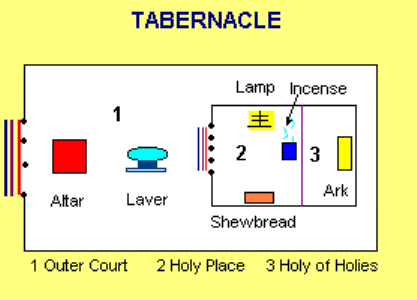

From the NIV Life Application Study Bible....
But what can all these ancient, complicated construction details show us today? First the high quality of the precious materials making up the tabernacle shows God's greatness and transcendence. Second, the curtain surrounding the Most Holy Place shows God's moral perfection as symbolized by his separation from the common and unclean. Third, the portable nature of the tabernacle shows God's desire to be with his people as they traveled. Fourth, the tabernacle, its furnishings, and the service performed there provide a picture of the atonement that would one day come through Jesus Christ.
The curtain separated the Holy Place and the Most Holy Place. The Most Holy Place was where God himself dwelt and the High Priest could only enter it once a year to make atonement for the sins of the nation as a whole. When Jesus died on the cross, this curtain in the temple (which replaced the tabernacle) was torn in two (Mark 15:38) symbolizing that His death now enabled us to have free access to God - we no longer had to approach Him through priests and sacrifices.
Here is a picture of the priest's ephod and breastplate.

SOAP
Scripture - Exodus 28:3 Tell all the skilled men to whom I have given wisdom in such matters that they are to make garments for Aaron, for his consecration, so he may serve me as priest.
Observation - God gave these skilled men the wisdom needed for the task He had given them.
Application - We need to think about our talents and abilities and how we can use them for God's glory - through His wisdom and strength.
Prayer - Lord, we thank you that your death on the cross has enabled us to have free access to You. We can approach your throne and have a relationship with you. Lord, we know you have given us our talents, our gifts, our strengths. Help us to use those gifts to glorify You through Your strength alone. Help us not to become proud of our abilities, but to always use them to glorify You. Amen
Tomorrow's passage is Exodus 29-31. Click here to read online.
I admit that this is another one of those passages that make my eyes glaze over a little and I find myself skimming instead of reading. Not good.Since we just got back from vacation, I haven't had too much time to dig into this too much, but I was able to find a few things that I wanted to share.
First of all - all the detail in these passages of exactly how everything in the tabernacle was to be made, is incredible. Here are a few images I found to help visualize what this is supposed to look like.
Here is a replica of the Ark of the Covenant.
Below is a replica of the table described in today's readings where the Bread of Presence is kept - (image below courtesy of BiblePlaces.com)
Here are a couple of images of the tabernacle and it's layout.
From the NIV Life Application Study Bible....
But what can all these ancient, complicated construction details show us today? First the high quality of the precious materials making up the tabernacle shows God's greatness and transcendence. Second, the curtain surrounding the Most Holy Place shows God's moral perfection as symbolized by his separation from the common and unclean. Third, the portable nature of the tabernacle shows God's desire to be with his people as they traveled. Fourth, the tabernacle, its furnishings, and the service performed there provide a picture of the atonement that would one day come through Jesus Christ.
The curtain separated the Holy Place and the Most Holy Place. The Most Holy Place was where God himself dwelt and the High Priest could only enter it once a year to make atonement for the sins of the nation as a whole. When Jesus died on the cross, this curtain in the temple (which replaced the tabernacle) was torn in two (Mark 15:38) symbolizing that His death now enabled us to have free access to God - we no longer had to approach Him through priests and sacrifices.
Here is a picture of the priest's ephod and breastplate.
SOAP
Scripture - Exodus 28:3 Tell all the skilled men to whom I have given wisdom in such matters that they are to make garments for Aaron, for his consecration, so he may serve me as priest.
Observation - God gave these skilled men the wisdom needed for the task He had given them.
Application - We need to think about our talents and abilities and how we can use them for God's glory - through His wisdom and strength.
Prayer - Lord, we thank you that your death on the cross has enabled us to have free access to You. We can approach your throne and have a relationship with you. Lord, we know you have given us our talents, our gifts, our strengths. Help us to use those gifts to glorify You through Your strength alone. Help us not to become proud of our abilities, but to always use them to glorify You. Amen
Tomorrow's passage is Exodus 29-31. Click here to read online.
Monday, February 8, 2010
February 8th Readings
Today's readings from the One Year Chronological Bible Reading Plan are Exodus 22:16-24:18
I cannot do anymore posts right now, per my husbands wishes. I e-mailed Tammy last week, but with her being on vacation, she must not have gotten it. Please just leave your thoughts about today's readings and share with one another as always! There is a lot of good stuff in today's readings. A lot of bad things too...that people were doing. It's amazing that some of those horrible, nasty things were done so early in history. It sure didn't take long for sin to destroy any descency in people. Even with starting all over after the flood, God is already having to give very detailed commandments and laws because of the sin of man.
Tomorrow's readings are Exodus 25:1-28:43. Click here to read online.
I cannot do anymore posts right now, per my husbands wishes. I e-mailed Tammy last week, but with her being on vacation, she must not have gotten it. Please just leave your thoughts about today's readings and share with one another as always! There is a lot of good stuff in today's readings. A lot of bad things too...that people were doing. It's amazing that some of those horrible, nasty things were done so early in history. It sure didn't take long for sin to destroy any descency in people. Even with starting all over after the flood, God is already having to give very detailed commandments and laws because of the sin of man.
Tomorrow's readings are Exodus 25:1-28:43. Click here to read online.
Sunday, February 7, 2010
Sunday February 7th Readings- Guest Post by Mrs.Oz
Today's passage from the One Year Chronological Bible Reading Plan is Exodus 20:1-22:15.
Just walk with me:
The Ten Commandments: The Moral Code of Life
So much to glean here. I'm struck by the simplicity and the preciseness of the commandments. They get right to the point. The most convicting to me today? Vs. 17:
"You shall not covet your neighbor's house; you shall not covet your neighbor's wife or his male servant or his female servant or his ox or his donkey or anything that belongs to your neighbor". May I take the liberty to "every day" this?
You shall not desire to have the beautiful house your friend has with it's new construction and nice neighborhood, large rooms and den. Even though it has hard wood floors you like so much and a big backyard with a pool, you are to be content with what the Lord has given you.
You shall not covet the man at church who's so much more of a leader in his home than your husband seems to be. You shall not compare your spouse to him in your mind and be discontent with the man that God has given unto you.
You shall not wish your income was as so-and-so's income is. You shall not covet their grocery allotment and whine and pine about yours being so much less. You shall not complain about the car you have that runs well but looks shabby.
This is so hard for all American women. Not to covet. WOW. Could you possibly hit us more at home? We have so much around us TO covet that is it such a struggle. I think of Paul often and how he learned to be content in any situation. I live in a double wide modular home in a park and I've learned to be so joyful that we have a place at all. We don't' have a nice view out any window. On one side I look at broken down vehicles my neighbor has and a rusty shed that is falling apart, and on the other side I look at a neighbor who let's weeds be their yard. There is no vista, no refreshing view of any kind, but I've learned that my home is what I make it in my gratitude of it.
Chapter 20:25 spoke to me:
"If you make an altar of stone for Me you shall not build it of cut stones, for if you wield your tool on it, you will profane it."
God at first says to make the altars to him of earth. Then, if they are of stone he wants them to be in their natural state. I was amazed at his intent to not let us think that we contributed ANYTHING in the sacrifices we give up to Him. He seems sensitive to our tendency to puff ourselves up with self righteous pride at any effort we put into it.
Next....
WOW...did you see 21:22? What a sweet refreshing breeze to hear God hold highly the life of the unborn! Praise Him! He treasures the woman who is with child and holds a life for a life if that child is harmed. I just was struck by the heart of God on this one. To take the time to put the unborn child in the passages proceeding the Ten Commandments was awesome of Him.
Beyond that I'm just struck by the continual thickness of integrity of these laws. To make things right, make restitution, is the theme of integrity. It was serious and final. We even see the death penalty supported here in 21:12, and grace for the man who murdered but did not do so with premeditation. There is such respect for life and authority on every level. God demonstrates his keen sense of justice and we read and love Him for it! It's so pure, and so right!
It's very much the law but very much the character of God as well that we see here and I think it's something to notice. It's a call to do right by those around you even if it cost you to do so. It's a conviction to call a spade a spade and not let political correctness change our moral fiber. It's black and white issues here, there is no grey. It's refreshing really in a world of wish-washy mamby-pamby decision making and the wicked becoming the victims.
It starts with us in our own hearts too and the example of integrity we set to those around us. Christ came to fulfill the law but there is still so much in the law that is beautiful and I really got a sense of harmonious beauty reading how things aught to be. If men could follow these rules, out of motivation for their God, then theocracy seems possible. The problem is, they cannot follow it. So the story continued. Yet, there is so much for us to learn about here as believers. We can practice these just commands out of love for God and for the Glory of His name.
Tomorrow's reading is: Exodus 22:16-24:18
Just walk with me:
The Ten Commandments: The Moral Code of Life
So much to glean here. I'm struck by the simplicity and the preciseness of the commandments. They get right to the point. The most convicting to me today? Vs. 17:
"You shall not covet your neighbor's house; you shall not covet your neighbor's wife or his male servant or his female servant or his ox or his donkey or anything that belongs to your neighbor". May I take the liberty to "every day" this?
You shall not desire to have the beautiful house your friend has with it's new construction and nice neighborhood, large rooms and den. Even though it has hard wood floors you like so much and a big backyard with a pool, you are to be content with what the Lord has given you.
You shall not covet the man at church who's so much more of a leader in his home than your husband seems to be. You shall not compare your spouse to him in your mind and be discontent with the man that God has given unto you.
You shall not wish your income was as so-and-so's income is. You shall not covet their grocery allotment and whine and pine about yours being so much less. You shall not complain about the car you have that runs well but looks shabby.
This is so hard for all American women. Not to covet. WOW. Could you possibly hit us more at home? We have so much around us TO covet that is it such a struggle. I think of Paul often and how he learned to be content in any situation. I live in a double wide modular home in a park and I've learned to be so joyful that we have a place at all. We don't' have a nice view out any window. On one side I look at broken down vehicles my neighbor has and a rusty shed that is falling apart, and on the other side I look at a neighbor who let's weeds be their yard. There is no vista, no refreshing view of any kind, but I've learned that my home is what I make it in my gratitude of it.
Chapter 20:25 spoke to me:
"If you make an altar of stone for Me you shall not build it of cut stones, for if you wield your tool on it, you will profane it."
God at first says to make the altars to him of earth. Then, if they are of stone he wants them to be in their natural state. I was amazed at his intent to not let us think that we contributed ANYTHING in the sacrifices we give up to Him. He seems sensitive to our tendency to puff ourselves up with self righteous pride at any effort we put into it.
Next....
WOW...did you see 21:22? What a sweet refreshing breeze to hear God hold highly the life of the unborn! Praise Him! He treasures the woman who is with child and holds a life for a life if that child is harmed. I just was struck by the heart of God on this one. To take the time to put the unborn child in the passages proceeding the Ten Commandments was awesome of Him.
Beyond that I'm just struck by the continual thickness of integrity of these laws. To make things right, make restitution, is the theme of integrity. It was serious and final. We even see the death penalty supported here in 21:12, and grace for the man who murdered but did not do so with premeditation. There is such respect for life and authority on every level. God demonstrates his keen sense of justice and we read and love Him for it! It's so pure, and so right!
It's very much the law but very much the character of God as well that we see here and I think it's something to notice. It's a call to do right by those around you even if it cost you to do so. It's a conviction to call a spade a spade and not let political correctness change our moral fiber. It's black and white issues here, there is no grey. It's refreshing really in a world of wish-washy mamby-pamby decision making and the wicked becoming the victims.
It starts with us in our own hearts too and the example of integrity we set to those around us. Christ came to fulfill the law but there is still so much in the law that is beautiful and I really got a sense of harmonious beauty reading how things aught to be. If men could follow these rules, out of motivation for their God, then theocracy seems possible. The problem is, they cannot follow it. So the story continued. Yet, there is so much for us to learn about here as believers. We can practice these just commands out of love for God and for the Glory of His name.
Tomorrow's reading is: Exodus 22:16-24:18
Friday, February 5, 2010
February 6-Pamela
Today's passage from the One-Year Bible Chronological Reading Plan is Exodus 16-19
Scripture: (2 that stood out for me)
Exodus 16:15b-20
Moses said to them, "It is the bread the LORD has given you to eat. 16 This is what the LORD has commanded: 'Each one is to gather as much as he needs. Take an omer for each person you have in your tent.' "
Exodus 18:17-18
17 Moses' father-in-law replied, "What you are doing is not good. 18 You and these people who come to you will only wear yourselves out. The work is too heavy for you; you cannot handle it alone.
Observations: The Lord will meet all of our needs. He will provide for us. He has a plan for us and we need to trust Him. It is not God's plan to have us do it all by ourselves. It is His plan for us to rely on Him.
Application: In our lives, we often fall short of fully trusting God to meet our needs. Even as the Israelites walked on dry land in the Red Sea to escape Pharaoh, they did not believe that God would provide them with all that they needed. In fact, they were whiny and demanding and outright rude saying that they were better off in Egypt. Yet, God granted their desires and met their needs. Many of them still did not trust in Him and chose to disobey the instructions to not keep any of the food until morning. How it must have broke God's heart to see His people doubt Him again and again....and even today, things have not changed.
I think it is our desire to give ourselves fully to trusting God, but our human nature that compels us to doubt. In my own life, God has revealed to me time and time again that He is in control. I try to let go and give myself fully to trusting His plan but there is a part of me that holds back and worries about what is to come. Just like the food that is held overnight goes rotten, my worries and fears can make my life stink. This is not the example that I want to live and share with others. It is not the example I want to give to my children. I think of the message that storing the food overnight sent to the children of those families. "I know Moses says that God will provide but just in case we are going to collect more food than we need..." I want my own children to have a different example of my faith in God's plan and ability to take care of our needs.
The other verses that stood out for me were just a good reminder that we are to share with others. I think we all can become overwhelmed sometimes. (This week has been a doozy for me personally). We need to learn to share our burdens to lighten the load. God never intended for us to do it all by ourselves. He wants to come along side us to meet all of our needs. The load life throws at us can be heavy sometimes and without support we can collapse under the weight of it. We are not alone. I think this passage reminds us about the importance of Christian friends and allowing them to support us in times of need. When Moses spread out his difficult load, he was able to be more effective in the role God had for him. In the same way, I believe when we bring our concerns to others and have them support us in prayer or in actions, we become more effective in God's plan for us.
Prayer: Heavenly Father, You are such a merciful God. We thank you for being patient with us as we strive to put our trust in You. You are the One who meets all our needs. You hear our prayers and you know our hearts. We often fall short of Your desire and yet you continue to work in us despite our flaws. Thank you. Lord, it is not Your plan for us to feel alone. Help us to rely on You and also on our brothers and sisters to support each other in prayer and to draw us closer to You. Continue to work in each of us according to the plan You have set for us. Amen.
Tomorrow's reading are Exodus 20:1-22:15.
Scripture: (2 that stood out for me)
Exodus 16:15b-20
Moses said to them, "It is the bread the LORD has given you to eat. 16 This is what the LORD has commanded: 'Each one is to gather as much as he needs. Take an omer for each person you have in your tent.' "
17 The Israelites did as they were told; some gathered much, some little. 18 And when they measured it by the omer, he who gathered much did not have too much, and he who gathered little did not have too little. Each one gathered as much as he needed.
19 Then Moses said to them, "No one is to keep any of it until morning."
20 However, some of them paid no attention to Moses; they kept part of it until morning, but it was full of maggots and began to smell. So Moses was angry with them.
Exodus 18:17-18
17 Moses' father-in-law replied, "What you are doing is not good. 18 You and these people who come to you will only wear yourselves out. The work is too heavy for you; you cannot handle it alone.
Observations: The Lord will meet all of our needs. He will provide for us. He has a plan for us and we need to trust Him. It is not God's plan to have us do it all by ourselves. It is His plan for us to rely on Him.
Application: In our lives, we often fall short of fully trusting God to meet our needs. Even as the Israelites walked on dry land in the Red Sea to escape Pharaoh, they did not believe that God would provide them with all that they needed. In fact, they were whiny and demanding and outright rude saying that they were better off in Egypt. Yet, God granted their desires and met their needs. Many of them still did not trust in Him and chose to disobey the instructions to not keep any of the food until morning. How it must have broke God's heart to see His people doubt Him again and again....and even today, things have not changed.
I think it is our desire to give ourselves fully to trusting God, but our human nature that compels us to doubt. In my own life, God has revealed to me time and time again that He is in control. I try to let go and give myself fully to trusting His plan but there is a part of me that holds back and worries about what is to come. Just like the food that is held overnight goes rotten, my worries and fears can make my life stink. This is not the example that I want to live and share with others. It is not the example I want to give to my children. I think of the message that storing the food overnight sent to the children of those families. "I know Moses says that God will provide but just in case we are going to collect more food than we need..." I want my own children to have a different example of my faith in God's plan and ability to take care of our needs.
The other verses that stood out for me were just a good reminder that we are to share with others. I think we all can become overwhelmed sometimes. (This week has been a doozy for me personally). We need to learn to share our burdens to lighten the load. God never intended for us to do it all by ourselves. He wants to come along side us to meet all of our needs. The load life throws at us can be heavy sometimes and without support we can collapse under the weight of it. We are not alone. I think this passage reminds us about the importance of Christian friends and allowing them to support us in times of need. When Moses spread out his difficult load, he was able to be more effective in the role God had for him. In the same way, I believe when we bring our concerns to others and have them support us in prayer or in actions, we become more effective in God's plan for us.
Prayer: Heavenly Father, You are such a merciful God. We thank you for being patient with us as we strive to put our trust in You. You are the One who meets all our needs. You hear our prayers and you know our hearts. We often fall short of Your desire and yet you continue to work in us despite our flaws. Thank you. Lord, it is not Your plan for us to feel alone. Help us to rely on You and also on our brothers and sisters to support each other in prayer and to draw us closer to You. Continue to work in each of us according to the plan You have set for us. Amen.
Tomorrow's reading are Exodus 20:1-22:15.
February 5th by tammi
Today's passage from the One-Year Bible Chronological Reading Plan is Exodus 13-15. Read online here.
Today's passage is probably one of the most exciting passages in the Old Testament. (In my opinion, anyway ~ for whatever that's worth!) Not only is it an incredible story, it offers great foreshadowing of the ultimate sacrifice of the Passover Lamb, a sacrifice to extend His deliverance beyond His chosen people; the gift of salvation made available to all mankind.
The first thing I found interesting is in the latter part of chapter 13 where God, leading with the pillar of cloud by day and the pillar of fire by night and speaking through Moses, actually reverses the Israelites' direction of travel. Up till this point, they'd been fleeing away from Egypt; now they are doubling back. Not only are they heading back towards Egypt, but from a military standpoint, are putting themselves in terrain that will make them extremely vulnerable, trapped between natural barriers ~ the mountains on either side and the Red Sea in front of them.
While the Bible says they were "armed for battle," the expression seems to indicate more their level of civil organization and possibly the weaponry they had amassed before their exodus, but it is doubtful that they were in any position to actually engage in full scale battle, especially since just one verse earlier (13:17), God specifically did NOT lead them through the land of the Philistines ~ which would have been a more direct route to Canaan, but would have required the use of an organized military force ~ because He didn't want them to lose heart at the thought of having to fight.
And yet here, hemmed in by the mountains and the Red Sea, God explains through Moses that this change of course was actually intended to encourage Pharaoh's pursuit! Man, if God didn't want them to lose heart at the prospect of war against the Philistines, this seems a little questionable. Like they weren't going to lose heart under THESE circumstances??!!
I love 14:4b: "But I will gain glory for myself through Pharaoh and all his army, and the Egyptians will know that I am the LORD." I love those "and then they will know that I am the LORD" statements ~ the OT is full of them. And remarkably, they pretty much always follow catastrophic events.
Some argue that God doesn't work that way anymore; that natural disasters and terrorist attacks, etcetera, are not specifically used by God anymore to show His holiness, but I don't know. Somehow that seems a little too uncomfortably presumptuous to me. We just don't understand God. But whether He specifically designs a tragic course of events or whether He's simply not stepped in to prevent it, our reaction can be a testament to His holiness, righteousness, love and grace, and His sovereignty in our lives.
After the Israelites deliverance from the Egyptians, we see Moses' beautiful song of praise and expectation of God's future provision and blessing for the nation in chapter 15. In sharp contrast, the chapter ends with the bitter water incident at Marah and the people's grumbling only three days after their miraculous journey through the Red Sea.
It always strikes me as incredible that they could so soon forget God's provision. After all, He was still leading them with the pillar of fire or cloud and He had led them to this place. You'd think even after discovering the water wasn't fit to drink that they'd remember the events of the previous 3 days and KNOW God would provide for them. It doesn't seem so, because this chapter ends on a bit of a sour note (pardon the pun!) and even though God turns the water sweet and promises to keep them healthy and disease-free if they listen to and obey Him, the somber tone of the end of this chapter sharply contrasts with its opening jubilation. And we know, of course, that this is only the beginning of 40 years of whining and complaining and NOT obeying God!
Finding the two contrasting events and moods in the same chapter seems odd, but two observations and consequent lessons can be learned here:
1. The Israelites failed to see the relationship between the affirmation of their faith in worship and the application of their faith in their daily walk. And oh, how true this is of me, too!! I can say the words over and over ~ "just give it to God" ~ but I almost never actually put that into practise when I'm worried or afraid! I've had to confess over and over of not allowing the head knowledge to become heart knowledge. We don't sing Moses' "Song of the Sea" in our churches these days (at least, not in ours), but how many other songs do we sing on a regular basis that really, if we're being very honest with ourselves, we don't actually mean or apply to our everyday lives? It Is Well With My Soul, Great is They Faithfulness, Higher Ground, He Leadeth Me, 'Tis So Sweet to Trust in Jesus..... the list goes on.
2. Not only did Israel fail to apply their faith to their situation at Marah, they failed to even see that it was a spiritual problem. Oh ouch! It's so easy to point fingers at the Israelites and their lack of faith in the face of what seems like the incredibly obvious presence, provision and blessing of God, but how often are we guilty of falling into exactly the same trap? We tend to view God as being concerned only with the "big" problems of life, but ANYTHING ~ no matter how trivial it might seem ~ which hinders our growth, our sanctification, or our ability to do what He has purposed is a matter about which He is DEEPLY concerned. It is also something He is fully capable of overcoming! Yet all too often, when faced with problems, we don't even consider that it is something about which God is intimately concerned, and we almost instinctively turn to secular solutions without seeking God's solution and allowing Him to work it out in His timing.
Notice also, that God didn't leave the Israelites singing by the sea. He didn't allow them to enjoy their spiritual high for very long. Instead, He promptly led them into the desert, allowed them to experience thirst and bitter water. This tested their faith and endurance, and provided the occasion to teach them (and us!) an important lesson: Expecting to live the Christian life on a continuous high is not only unrealistic, it is unbiblical. We need to thank God in times of victory and elation, but we should not expect things to stay that way forever if we want to grow. It is in the Refiner's fire that we are purified.
(Interestingly, this is another parallel or foreshadowing of Jesus' life: His public life and ministry also started out with a celebration at a body of water ~ His baptism ~ and was immediately followed by 40 days of desert-bound refining. Neat, eh?!)
Boy, did I need to preach this to myself this week!! I am always amazed at God's timing. I have been choosing fear over faith for a while now and struggling with a bit of depression over the last few weeks as a result. Studying this passage these last few days was the kick in the pants I so badly needed! Thanks, Tammy, for asking me to post about this one!!


Insight for this passage gleaned from a few resources, but primarily these two commentaries: The Red Sea: Israel's Deliverance and Egypt's Defeat and The Song of the Sea.
Tomorrow's passage: Exodus 16-19.
Today's passage is probably one of the most exciting passages in the Old Testament. (In my opinion, anyway ~ for whatever that's worth!) Not only is it an incredible story, it offers great foreshadowing of the ultimate sacrifice of the Passover Lamb, a sacrifice to extend His deliverance beyond His chosen people; the gift of salvation made available to all mankind.
The first thing I found interesting is in the latter part of chapter 13 where God, leading with the pillar of cloud by day and the pillar of fire by night and speaking through Moses, actually reverses the Israelites' direction of travel. Up till this point, they'd been fleeing away from Egypt; now they are doubling back. Not only are they heading back towards Egypt, but from a military standpoint, are putting themselves in terrain that will make them extremely vulnerable, trapped between natural barriers ~ the mountains on either side and the Red Sea in front of them.
While the Bible says they were "armed for battle," the expression seems to indicate more their level of civil organization and possibly the weaponry they had amassed before their exodus, but it is doubtful that they were in any position to actually engage in full scale battle, especially since just one verse earlier (13:17), God specifically did NOT lead them through the land of the Philistines ~ which would have been a more direct route to Canaan, but would have required the use of an organized military force ~ because He didn't want them to lose heart at the thought of having to fight.
And yet here, hemmed in by the mountains and the Red Sea, God explains through Moses that this change of course was actually intended to encourage Pharaoh's pursuit! Man, if God didn't want them to lose heart at the prospect of war against the Philistines, this seems a little questionable. Like they weren't going to lose heart under THESE circumstances??!!
I love 14:4b: "But I will gain glory for myself through Pharaoh and all his army, and the Egyptians will know that I am the LORD." I love those "and then they will know that I am the LORD" statements ~ the OT is full of them. And remarkably, they pretty much always follow catastrophic events.
Some argue that God doesn't work that way anymore; that natural disasters and terrorist attacks, etcetera, are not specifically used by God anymore to show His holiness, but I don't know. Somehow that seems a little too uncomfortably presumptuous to me. We just don't understand God. But whether He specifically designs a tragic course of events or whether He's simply not stepped in to prevent it, our reaction can be a testament to His holiness, righteousness, love and grace, and His sovereignty in our lives.
After the Israelites deliverance from the Egyptians, we see Moses' beautiful song of praise and expectation of God's future provision and blessing for the nation in chapter 15. In sharp contrast, the chapter ends with the bitter water incident at Marah and the people's grumbling only three days after their miraculous journey through the Red Sea.
It always strikes me as incredible that they could so soon forget God's provision. After all, He was still leading them with the pillar of fire or cloud and He had led them to this place. You'd think even after discovering the water wasn't fit to drink that they'd remember the events of the previous 3 days and KNOW God would provide for them. It doesn't seem so, because this chapter ends on a bit of a sour note (pardon the pun!) and even though God turns the water sweet and promises to keep them healthy and disease-free if they listen to and obey Him, the somber tone of the end of this chapter sharply contrasts with its opening jubilation. And we know, of course, that this is only the beginning of 40 years of whining and complaining and NOT obeying God!
Finding the two contrasting events and moods in the same chapter seems odd, but two observations and consequent lessons can be learned here:
1. The Israelites failed to see the relationship between the affirmation of their faith in worship and the application of their faith in their daily walk. And oh, how true this is of me, too!! I can say the words over and over ~ "just give it to God" ~ but I almost never actually put that into practise when I'm worried or afraid! I've had to confess over and over of not allowing the head knowledge to become heart knowledge. We don't sing Moses' "Song of the Sea" in our churches these days (at least, not in ours), but how many other songs do we sing on a regular basis that really, if we're being very honest with ourselves, we don't actually mean or apply to our everyday lives? It Is Well With My Soul, Great is They Faithfulness, Higher Ground, He Leadeth Me, 'Tis So Sweet to Trust in Jesus..... the list goes on.
2. Not only did Israel fail to apply their faith to their situation at Marah, they failed to even see that it was a spiritual problem. Oh ouch! It's so easy to point fingers at the Israelites and their lack of faith in the face of what seems like the incredibly obvious presence, provision and blessing of God, but how often are we guilty of falling into exactly the same trap? We tend to view God as being concerned only with the "big" problems of life, but ANYTHING ~ no matter how trivial it might seem ~ which hinders our growth, our sanctification, or our ability to do what He has purposed is a matter about which He is DEEPLY concerned. It is also something He is fully capable of overcoming! Yet all too often, when faced with problems, we don't even consider that it is something about which God is intimately concerned, and we almost instinctively turn to secular solutions without seeking God's solution and allowing Him to work it out in His timing.
Notice also, that God didn't leave the Israelites singing by the sea. He didn't allow them to enjoy their spiritual high for very long. Instead, He promptly led them into the desert, allowed them to experience thirst and bitter water. This tested their faith and endurance, and provided the occasion to teach them (and us!) an important lesson: Expecting to live the Christian life on a continuous high is not only unrealistic, it is unbiblical. We need to thank God in times of victory and elation, but we should not expect things to stay that way forever if we want to grow. It is in the Refiner's fire that we are purified.
(Interestingly, this is another parallel or foreshadowing of Jesus' life: His public life and ministry also started out with a celebration at a body of water ~ His baptism ~ and was immediately followed by 40 days of desert-bound refining. Neat, eh?!)
Boy, did I need to preach this to myself this week!! I am always amazed at God's timing. I have been choosing fear over faith for a while now and struggling with a bit of depression over the last few weeks as a result. Studying this passage these last few days was the kick in the pants I so badly needed! Thanks, Tammy, for asking me to post about this one!!
Insight for this passage gleaned from a few resources, but primarily these two commentaries: The Red Sea: Israel's Deliverance and Egypt's Defeat and The Song of the Sea.
Tomorrow's passage: Exodus 16-19.
Wednesday, February 3, 2010
February 4th by Nicole
Today's readings are taken from Exodus 10:1-12:51. You can read along HERE
Today continues with the last of the plagues on Egypt. The thing that really stood out to me was the plague of darkness where it could "be felt" (v 21). Darkness that could be felt. I just tried to picture what that would be like, to FEEL the darkness. It would of been terrifying. To not be able to see a thing, to feel this darkness, this load, heaviness all around. Then I thought that it is what hell will be like. Utter darkness, for God is light and He will not be there. What a horrid horrid place, a place to be in darkness that you can FEEL forever. Thank God that He saved me from that place...
The last plague that gets Pharaoh's attention at last is the plague on the first born son (chapter 11). It is here that God outlines "Passover" when he passes over the house that has the blood of the lamb sprinkled on the doorways and does not kill the first born son.
My mother's family are Jewish, more culturally I would think than religiously, although my Nanna does go to Synagogue and light candles and do all those other things, noone else in the family does much else. I never really GOT what Passover was (and I celebrated 20 years of them before I became a Christian) until I became a Christian. To me it means SO much more now than it did back then. Mainly the lamb that is sacfriced, without blemish, just as our Saviour Jesus was. The herbs that were to be eaten were to help the Israelites to recall the bitter years of slavery and the unleavened bread was a reflection on their haste to leave Egypt. To me it just showed that with God, EVERYTHING has a meaning behind it and a purpose. He didn't just say to eat something because he thought it would taste good (or yuck! those bitter herbs are bitter LOL), or because he thought it would be entertaining or whatever. When God says something its for a meaning a purpose. I am trying to hold on to that at the moment as I go through a trial that I have been going through for some years now. That everything that is happening has a reason, a purpose and God will bring me out like he brought the Israelites out.
What spoke to you in these verses today?
Tomorrow's readings are from Exodus 13:1-15:27
Today continues with the last of the plagues on Egypt. The thing that really stood out to me was the plague of darkness where it could "be felt" (v 21). Darkness that could be felt. I just tried to picture what that would be like, to FEEL the darkness. It would of been terrifying. To not be able to see a thing, to feel this darkness, this load, heaviness all around. Then I thought that it is what hell will be like. Utter darkness, for God is light and He will not be there. What a horrid horrid place, a place to be in darkness that you can FEEL forever. Thank God that He saved me from that place...
The last plague that gets Pharaoh's attention at last is the plague on the first born son (chapter 11). It is here that God outlines "Passover" when he passes over the house that has the blood of the lamb sprinkled on the doorways and does not kill the first born son.
My mother's family are Jewish, more culturally I would think than religiously, although my Nanna does go to Synagogue and light candles and do all those other things, noone else in the family does much else. I never really GOT what Passover was (and I celebrated 20 years of them before I became a Christian) until I became a Christian. To me it means SO much more now than it did back then. Mainly the lamb that is sacfriced, without blemish, just as our Saviour Jesus was. The herbs that were to be eaten were to help the Israelites to recall the bitter years of slavery and the unleavened bread was a reflection on their haste to leave Egypt. To me it just showed that with God, EVERYTHING has a meaning behind it and a purpose. He didn't just say to eat something because he thought it would taste good (or yuck! those bitter herbs are bitter LOL), or because he thought it would be entertaining or whatever. When God says something its for a meaning a purpose. I am trying to hold on to that at the moment as I go through a trial that I have been going through for some years now. That everything that is happening has a reason, a purpose and God will bring me out like he brought the Israelites out.
What spoke to you in these verses today?
Tomorrow's readings are from Exodus 13:1-15:27
Wednesday, February 3rd - PamJ
Today's readings from the Chronological Plan are Exodus 7:14-9:35. Click here to read online.
Miriam said it VERY well yesterday about Pharaoh demonstrating his power by hardening his heart. Little did he know, the power of the Lord wouldn't make it easy for him.
Moses and Aaron changed the water of the Nile to blood. The fish died and stank. The Egyptians could no longer drink it's water and had to dig around it for their drinking water. The Egyptian magician's also did the sames things, and Pharaoh was not bothered.
Then came the plague of the frogs. Aaron stretched his hand over the waters and they came up and were everywhere! Although the magicians did this as well. I don't fully understand the purpose of the magicians doing these things as well. Perhaps it aided in the Pharaoh's denial of God.
It was Pharaoh who finally came up to Moses and Aaron, begging for them to get God to take away the hordes of frogs. He offered to let the people go, and Moses said he would pray for him and his people. Agreed. The next day they prayed, the frogs died and were piled in heaps, and yet again Pharaoh's heart was hardened.
This was followed by the plague of the gnats, the flies, the livestock, also plagues of boils and hail. Even the magicians told Pharaoh that this was the work of God!! But he refused to hear and acknowledge it.
It is important to note that the plague of the flies were not in the land of Goshen where the Isrealites lived. Their livestocks was also not affected. God wanted to make that 'distinction between my people and your people' Exodus 8:23.
Pharaoh promised twice that he would return the people. He broke that promise as many times. He only made those promised to end the plagues. To bring comfort to himself. As soon as they were over he sinned and took back his promises. My Bible's insert says "It's quite easy for us to form the habit of keeping our word only when it's comfortable. Examine your dealings with others, and unlearn any sinful habits before, like Pharaoh, you must learn the hard way." Making promises and going through with them please people. It shows that you are loyal and can be trusted. If you take back those and do not pull through, it is harder for others to trust in you. We can trust in God, because he never fails on his promises!
God knew that Pharaoh's heart would be hardened each and every time. Pharaoh was stubborn. I see those qualities in myself at times. I beg God to change something that may not be going in my favor, then after? I forget and move on to the next thing until I need him to fix something again. He wants to be the CONSTANT in our lives. By denying Him, He does not remove Himself from the scene. It merely removes the opportunity to relate to God. He remains the same. Always there. Just waiting for you.
Tomorrow's reading are Exodus 10 - 12:51. Click here to read online.
Miriam said it VERY well yesterday about Pharaoh demonstrating his power by hardening his heart. Little did he know, the power of the Lord wouldn't make it easy for him.
Moses and Aaron changed the water of the Nile to blood. The fish died and stank. The Egyptians could no longer drink it's water and had to dig around it for their drinking water. The Egyptian magician's also did the sames things, and Pharaoh was not bothered.
Then came the plague of the frogs. Aaron stretched his hand over the waters and they came up and were everywhere! Although the magicians did this as well. I don't fully understand the purpose of the magicians doing these things as well. Perhaps it aided in the Pharaoh's denial of God.
It was Pharaoh who finally came up to Moses and Aaron, begging for them to get God to take away the hordes of frogs. He offered to let the people go, and Moses said he would pray for him and his people. Agreed. The next day they prayed, the frogs died and were piled in heaps, and yet again Pharaoh's heart was hardened.
This was followed by the plague of the gnats, the flies, the livestock, also plagues of boils and hail. Even the magicians told Pharaoh that this was the work of God!! But he refused to hear and acknowledge it.
It is important to note that the plague of the flies were not in the land of Goshen where the Isrealites lived. Their livestocks was also not affected. God wanted to make that 'distinction between my people and your people' Exodus 8:23.
Pharaoh promised twice that he would return the people. He broke that promise as many times. He only made those promised to end the plagues. To bring comfort to himself. As soon as they were over he sinned and took back his promises. My Bible's insert says "It's quite easy for us to form the habit of keeping our word only when it's comfortable. Examine your dealings with others, and unlearn any sinful habits before, like Pharaoh, you must learn the hard way." Making promises and going through with them please people. It shows that you are loyal and can be trusted. If you take back those and do not pull through, it is harder for others to trust in you. We can trust in God, because he never fails on his promises!
God knew that Pharaoh's heart would be hardened each and every time. Pharaoh was stubborn. I see those qualities in myself at times. I beg God to change something that may not be going in my favor, then after? I forget and move on to the next thing until I need him to fix something again. He wants to be the CONSTANT in our lives. By denying Him, He does not remove Himself from the scene. It merely removes the opportunity to relate to God. He remains the same. Always there. Just waiting for you.
Tomorrow's reading are Exodus 10 - 12:51. Click here to read online.
Tuesday, February 2, 2010
February 2 - Guest Post by Miriam
Today's reading is Exodus 4:18-7:13. Click here to read the passage on-line.
It must have been obvious to the Israelites at the time that Moses' and Aaron's coming had made their situation worse instead of better. Pharoah became more cruel to them, requiring them to gather their own straw and still make as many bricks as they had made before. I'm sure that they were mistreated - beaten, certainly, and some probably died. "How is this a deliverance?" they must have wondered. The Israelite foremen complained to Moses and Aaron, and Moses complained to God. "O Lord, why have you brought trouble upon this people? Is this why you sent me? Ever since I went to Pharaoh to speak in your name, he has brought trouble upon this people, and you have not rescued your people at all." Exodus 5:22-23
And God says:
'I am the LORD, and I will bring you out from under the yoke of the Egyptians. I will free you from being slaves to them, and I will redeem you with an outstretched arm and with mighty acts of judgment. I will take you as my own people, and I will be your God. Then you will know that I am the LORD your God, who brought you out from under the yoke of the Egyptians. And I will bring you to the land I swore with uplifted hand to give to Abraham, to Isaac and to Jacob. I will give it to you as a possession. I am the LORD.' Exodus 6:6-8
God purposefully hardened Pharoah's heart against Moses and Aaron in order to demonstrate his power, not only to the Egyptians but also to the Israelites who were his chosen people -- his firstborn son, according to Exodus 4:22. The Israelites were treated cruelly for no other reason than because Pharoah was afraid of how large a nation they were becoming, having done nothing to bring this on themselves, and God used this situation to show them "miraculous signs and wonders" so that they would know and believe that he could and would take care of them and fulfill his promise. This goes back to something we learned from Job. Not all trials and tribulations are punishments or consequences of our actions. The Israelites were enslaved so that God could show them (and also the Egyptians, but I believe the message was meant more for the Israelites), clearly and in no uncertain terms, that he is God. He has power over everything. He is in control. But it didn't seem that way at first. Things got much worse before they got better.
We struggle with waiting for God's timing. He knew they needed more demonstrations. He knew that their faith would be weak if they were too easily let go. The more demonstrations or miraculous signs and wonders he performed, the stronger their belief would be in what he could do in the future. And we, like them, are human and we want proof. "Show me, God!"
As I read, I thought "Wouldn't it be great if God demonstrated his power so evidently now?" But then, I realized he does all the time - in nature, which those who are scientifically minded prefer to explain by other means. I believe that his power is demonstrated on a daily basis to those who choose to see it. Not only that, but we also have the record of his previous signs and wonders in the Bible.
I see God's hand in every living thing around me, when I think about it. The workings of the body. The development of a baby inside its mother. Trees, grass, flowers, even weeds. Animals, birds, sea life, and those mosquitoes we're plagued with every summer. The warmth of the sun. The refreshment of rain. The light breeze that carries the scent of blossoms. And then there are the more violent demonstrations. Thunder. Lightning. Blizzards. Hail. Hurricanes. Earthquakes. We serve a great and powerful God. What a wonder that he should care for us.
Tomorrow's reading is Exodus 7:14-9:35. Click here to read on-line.
It must have been obvious to the Israelites at the time that Moses' and Aaron's coming had made their situation worse instead of better. Pharoah became more cruel to them, requiring them to gather their own straw and still make as many bricks as they had made before. I'm sure that they were mistreated - beaten, certainly, and some probably died. "How is this a deliverance?" they must have wondered. The Israelite foremen complained to Moses and Aaron, and Moses complained to God. "O Lord, why have you brought trouble upon this people? Is this why you sent me? Ever since I went to Pharaoh to speak in your name, he has brought trouble upon this people, and you have not rescued your people at all." Exodus 5:22-23
And God says:
'I am the LORD, and I will bring you out from under the yoke of the Egyptians. I will free you from being slaves to them, and I will redeem you with an outstretched arm and with mighty acts of judgment. I will take you as my own people, and I will be your God. Then you will know that I am the LORD your God, who brought you out from under the yoke of the Egyptians. And I will bring you to the land I swore with uplifted hand to give to Abraham, to Isaac and to Jacob. I will give it to you as a possession. I am the LORD.' Exodus 6:6-8
God purposefully hardened Pharoah's heart against Moses and Aaron in order to demonstrate his power, not only to the Egyptians but also to the Israelites who were his chosen people -- his firstborn son, according to Exodus 4:22. The Israelites were treated cruelly for no other reason than because Pharoah was afraid of how large a nation they were becoming, having done nothing to bring this on themselves, and God used this situation to show them "miraculous signs and wonders" so that they would know and believe that he could and would take care of them and fulfill his promise. This goes back to something we learned from Job. Not all trials and tribulations are punishments or consequences of our actions. The Israelites were enslaved so that God could show them (and also the Egyptians, but I believe the message was meant more for the Israelites), clearly and in no uncertain terms, that he is God. He has power over everything. He is in control. But it didn't seem that way at first. Things got much worse before they got better.
We struggle with waiting for God's timing. He knew they needed more demonstrations. He knew that their faith would be weak if they were too easily let go. The more demonstrations or miraculous signs and wonders he performed, the stronger their belief would be in what he could do in the future. And we, like them, are human and we want proof. "Show me, God!"
As I read, I thought "Wouldn't it be great if God demonstrated his power so evidently now?" But then, I realized he does all the time - in nature, which those who are scientifically minded prefer to explain by other means. I believe that his power is demonstrated on a daily basis to those who choose to see it. Not only that, but we also have the record of his previous signs and wonders in the Bible.
I see God's hand in every living thing around me, when I think about it. The workings of the body. The development of a baby inside its mother. Trees, grass, flowers, even weeds. Animals, birds, sea life, and those mosquitoes we're plagued with every summer. The warmth of the sun. The refreshment of rain. The light breeze that carries the scent of blossoms. And then there are the more violent demonstrations. Thunder. Lightning. Blizzards. Hail. Hurricanes. Earthquakes. We serve a great and powerful God. What a wonder that he should care for us.
Tomorrow's reading is Exodus 7:14-9:35. Click here to read on-line.
Monday, February 1, 2010
February 1st Readings~Guest Post By Kristi
Today's readings from the Chronological Plan are Exodus 1-2:25; 1 Chronicles 6:1-3; Exodus 3-4:17. Click here to read online.
There is so much in these verses that could be pointed out, or talked about, but these are all pretty well known and easily understood. Therefore, I am going to go with the SOAP approach today.
Scripture~ "And Moses said unto God, Who am I, that I should go unto Pharaoh, and that I should bring forth the children of Israel out of Egypt?" Exodus 3:11
Observation~ Moses instantly dwells on the thought of how hard the task asked of him is. He doesn't even hear all the details before he questions God about His request. He's already asking why God wants him to do it, and who is he, that God would have him to do this. Then he questions how and why and comes up with every excuse he can think of, for why it won't work(4:1), and why he shouldn't be the one to do it(4:10). In verse 14 we see that God gets angry with Moses, and brings in Aaron to assist Moses in this great task that will come to be.
Application~ It is so easy for us to question our abilities and try to think through how situations are going to work or not work. But when God asks things of us, we need to trust and obey. We don't hear God audibly, so yes, we do need to pray about things and make sure they are God's will, but when we know He is calling us to do something, we need to trust who He is, and the power that He has, and just do it. God does not call the equipped, He equips the called...so that He will get the honor and the glory.
When my oldest son was getting close to school age, my husband and I had to come to a final decision on what we were going to do about his education. Were we going to put him in public school, or were we going to homeschool? (We had never heard of homeschooling before, and didn't know the slightest thing about it. We were very ignorant to just how much is out there to make sure homeschooled children get exceedingly wonderful educations.) This question arose again and again even after we had been homeschooling him for quite sometime. Every time things got hard, I would question my abilities and try to reason everything out over the next 12 years. What if I don't do a good enough job? What if colleges won't accept him? Am I smart enough to do this? What do other people think about what we are doing? I remember looking at my husband one day when I was almost in tears over the frustration of making this "all so important decision" and telling him, "if I knew the world was going to end and Jesus would take us home before he needed to go to college or support a family, I would homeschool him without any question." I wanted to see the future so I could make an informed decision. We even put him in public school for 2 or 3 months when he was in second grade, and then something happened.
God spoke to me so clearly, you would have thought it was audible. He said, trust in me, follow My will, and take it one day at a time. Don't look to the future, look to Me...just keep your eyes on Me. Don't question your abilities, because my strength is perfect in your weakness. I will give you ALL you stand in need of to do My will. I took my son out of school that day and we've never looked back. When times get tough, we look to God and work through them because there is no alternative anymore. Now we have 3 out of our 4 children homeschooling, and the littlest one can't wait to get started next. I am amazed every day at how good of a teacher I am (WITH THE LORD'S HELP...I fail miserably if I'm not teaching behind His leadership), and how much my children thrive in the environment they are in. Every day that I get to teach them, and instruct them in a safe, loving home with Godly values along side their needed education, I just thank God for not letting me ruin what we have. God has since blessed me with many resources for homeschooling that make the future look a lot brighter. As well as many people around us who were homeschooled and now have successful carriers, and are homeschooling their own children.
God doesn't give us our life's story book to read before we live it. Honestly, I don't think we could handle it anyway. We just have to deny ourselves and let God lead. We shouldn't be asking Him, Who am I...to teach that Sunday School class? ...to witness to my neighbors?...to move to a new city? ...to lead a bible study? ...to have another child? We shouldn't be listing our imperfections to Him either as Moses did in verse 10 of chapter 4. Look at God's response again... "Who hath made man's mouth? or who maketh the dumb, or deaf, or the seeing, or the blind? have not I the Lord?" Exodous 4:11 God made us, He knows what we are and are not capable of. He will not ask of us something we cannot already do, or something He won't give us the ability to do. How blessed we can be, and how blessed others can be through us, if we will just obey.
Prayer~ Father, I thank you and praise you for all that you are, and all that you do. I pray that you would speak to me and let me know what your will is for me. Open my heart Lord, and show me the things you would have me to be doing in my life. For those things you've already asked of me Lord, I surrender them to you. Please give me the strength I need to trust in you and to do that which you have asked of me. Provide me with all that I stand in need of, to do your will and stay in the path that you have laid for my life. Forgive me for questioning you and not fully obeying. May all that I do give you honor and praise, in Jesus name, Amen.
Tomorrow's readings are Exodus 4:18-7:13
There is so much in these verses that could be pointed out, or talked about, but these are all pretty well known and easily understood. Therefore, I am going to go with the SOAP approach today.
Scripture~ "And Moses said unto God, Who am I, that I should go unto Pharaoh, and that I should bring forth the children of Israel out of Egypt?" Exodus 3:11
Observation~ Moses instantly dwells on the thought of how hard the task asked of him is. He doesn't even hear all the details before he questions God about His request. He's already asking why God wants him to do it, and who is he, that God would have him to do this. Then he questions how and why and comes up with every excuse he can think of, for why it won't work(4:1), and why he shouldn't be the one to do it(4:10). In verse 14 we see that God gets angry with Moses, and brings in Aaron to assist Moses in this great task that will come to be.
Application~ It is so easy for us to question our abilities and try to think through how situations are going to work or not work. But when God asks things of us, we need to trust and obey. We don't hear God audibly, so yes, we do need to pray about things and make sure they are God's will, but when we know He is calling us to do something, we need to trust who He is, and the power that He has, and just do it. God does not call the equipped, He equips the called...so that He will get the honor and the glory.
When my oldest son was getting close to school age, my husband and I had to come to a final decision on what we were going to do about his education. Were we going to put him in public school, or were we going to homeschool? (We had never heard of homeschooling before, and didn't know the slightest thing about it. We were very ignorant to just how much is out there to make sure homeschooled children get exceedingly wonderful educations.) This question arose again and again even after we had been homeschooling him for quite sometime. Every time things got hard, I would question my abilities and try to reason everything out over the next 12 years. What if I don't do a good enough job? What if colleges won't accept him? Am I smart enough to do this? What do other people think about what we are doing? I remember looking at my husband one day when I was almost in tears over the frustration of making this "all so important decision" and telling him, "if I knew the world was going to end and Jesus would take us home before he needed to go to college or support a family, I would homeschool him without any question." I wanted to see the future so I could make an informed decision. We even put him in public school for 2 or 3 months when he was in second grade, and then something happened.
God spoke to me so clearly, you would have thought it was audible. He said, trust in me, follow My will, and take it one day at a time. Don't look to the future, look to Me...just keep your eyes on Me. Don't question your abilities, because my strength is perfect in your weakness. I will give you ALL you stand in need of to do My will. I took my son out of school that day and we've never looked back. When times get tough, we look to God and work through them because there is no alternative anymore. Now we have 3 out of our 4 children homeschooling, and the littlest one can't wait to get started next. I am amazed every day at how good of a teacher I am (WITH THE LORD'S HELP...I fail miserably if I'm not teaching behind His leadership), and how much my children thrive in the environment they are in. Every day that I get to teach them, and instruct them in a safe, loving home with Godly values along side their needed education, I just thank God for not letting me ruin what we have. God has since blessed me with many resources for homeschooling that make the future look a lot brighter. As well as many people around us who were homeschooled and now have successful carriers, and are homeschooling their own children.
God doesn't give us our life's story book to read before we live it. Honestly, I don't think we could handle it anyway. We just have to deny ourselves and let God lead. We shouldn't be asking Him, Who am I...to teach that Sunday School class? ...to witness to my neighbors?...to move to a new city? ...to lead a bible study? ...to have another child? We shouldn't be listing our imperfections to Him either as Moses did in verse 10 of chapter 4. Look at God's response again... "Who hath made man's mouth? or who maketh the dumb, or deaf, or the seeing, or the blind? have not I the Lord?" Exodous 4:11 God made us, He knows what we are and are not capable of. He will not ask of us something we cannot already do, or something He won't give us the ability to do. How blessed we can be, and how blessed others can be through us, if we will just obey.
Prayer~ Father, I thank you and praise you for all that you are, and all that you do. I pray that you would speak to me and let me know what your will is for me. Open my heart Lord, and show me the things you would have me to be doing in my life. For those things you've already asked of me Lord, I surrender them to you. Please give me the strength I need to trust in you and to do that which you have asked of me. Provide me with all that I stand in need of, to do your will and stay in the path that you have laid for my life. Forgive me for questioning you and not fully obeying. May all that I do give you honor and praise, in Jesus name, Amen.
Tomorrow's readings are Exodus 4:18-7:13
Subscribe to:
Posts (Atom)